Project Type
Self-Initiated Concept Study
Tools
Figma
Core Pillars
Service Design
Information Architecture
Wayfinding and Commuting Experience
The Tropical Metro: Redesigning Singapore's Transit Experience
A self-initiated concept study reimagining Singapore's metro as a warm, inclusive and navigable city discovery — for the daily commuter and the first-time visitor alike. After all, Singapore's transit network is one of the best in the world. This study asks: can it also feel like Singapore?
This is an ongoing study — updated as the research deepens and the design evolves. What you see here reflects the current state of an active inquiry, not a finished proposal.
Foreword
Context
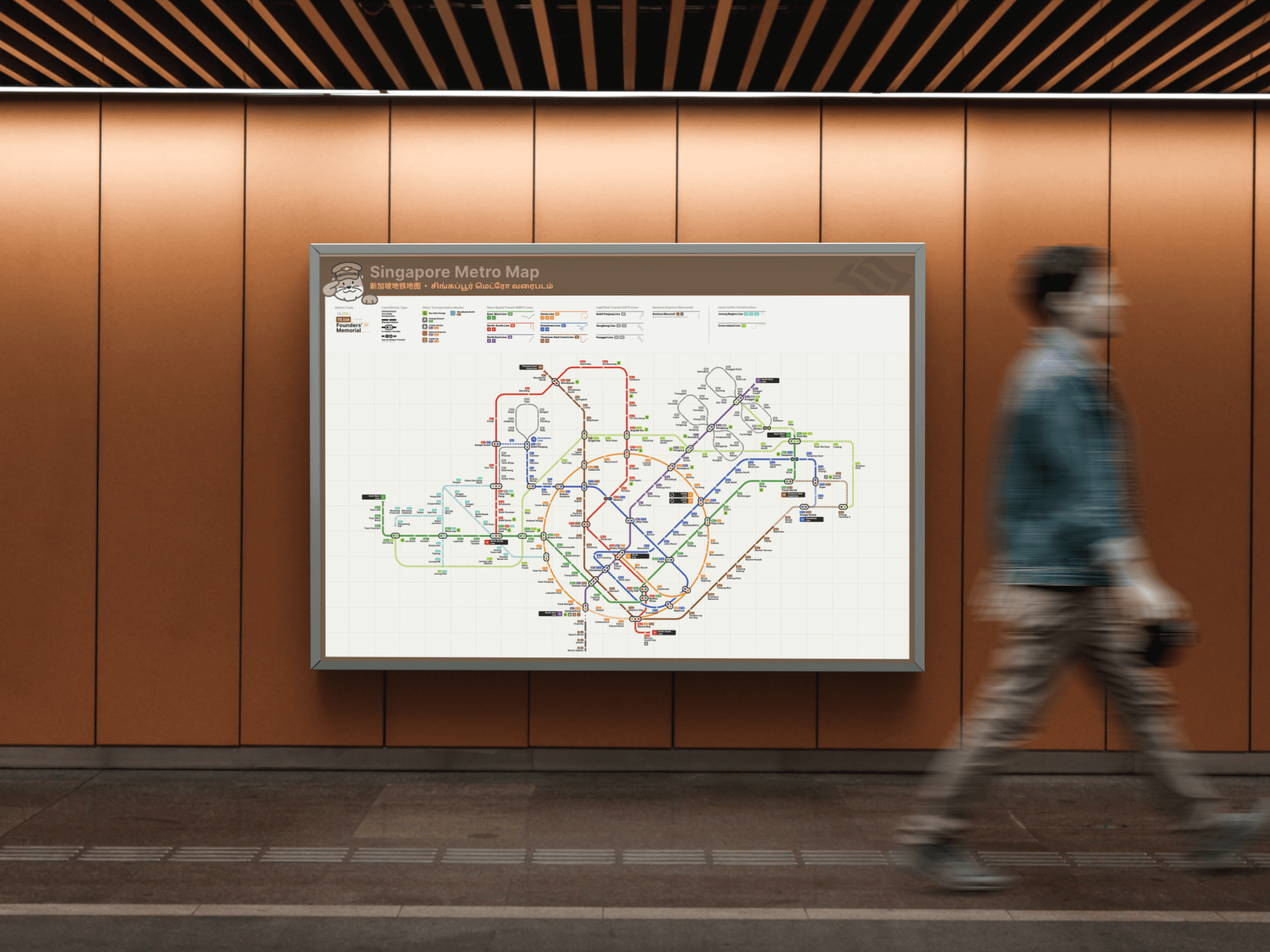
Singapore's MRT network is one of the most expansive and reliable in the world. But expansion brings complexity. As new lines open and interchange stations multiply, the traditional system map is being pushed toward the edges of cognitive manageability — more lines, more colours, more station codes, more information competing for attention on a single diagram.
This project addresses that challenge through two lenses: the macro experience of reading and understanding the system map, and the micro experience of navigating through a physical station. Both matter. And right now, they don't always speak the same language.
This project seeks to address identified gaps by redesigning the transit map and wayfinding experience to be more:
[1] Intuitive, by reducing cognitive load at decision points
[2] Inclusive, by serving the full diversity of Singapore's ridership
[3] Grounded in identity, by reflecting Singapore's warm, tropical, 'City in Nature' character.
A Broad Overview of the Problems Discovered
Over several sessions at stations across the network, I photographed the system as a first-time critical observer: the signage hierarchy, the typography in use, the colour-coding logic (and its breakdowns), the spatial transitions between concourse and platform, and the moments where a commuter might pause, backtrack, or hesitate.
What I found wasn't a single broken thing. It was a coherence problem — a system assembled from parts that had never been asked to speak the same language.
Specific observations included:
Operator fragmentation: The MRT network is operated by multiple entities — SMRT and SBS Transit — each with subtly different visual conventions, creating friction at interchange stations where both co-exist.
Signage inconsistency: Guerrilla-style hand-lettered signs appear in stations alongside official ones, suggesting the official system isn't fully meeting wayfinding needs on the ground.
A map that serves geography, not psychology: The existing network map prioritises topographic accuracy. It does not prioritise cognitive legibility — the sense of spatial relationships, landmark anchoring, or neighbourhood identity that helps people build a mental model of the city they're moving through.
No tropical identity: Singapore is a tropical city with a rich multicultural visual heritage. Its transit system borrows its visual vocabulary almost entirely from European and East Asian precedents. The result is a system that could belong to any modern city — which means it belongs fully to none of them.
A Quick Note
Understandably, not all of the problems discovered may be solved by UX alone. Sometimes, these problems may be better addressed by designing better conditions for human interaction, such as having a staff member on the ground to guide a confused elderly or a person with disabilities to their desired location.
Additionally, UX here also comprises both the physical and digital touch-points across the whole commuter journey, from commuting and wayfinding, to planning and managing/monitoring the stored value left on the transit card.
Methodology & Strategic Approach
Environmental Audit
Field visits across multiple MRT lines and interchange stations, documenting signage inconsistencies, wayfinding failures, and commuter behaviour at decision points. Stations visited span all major operators and line generations — from legacy NSL stations to new TEL openings.
Heuristic Evaluation
The existing system map was evaluated against established wayfinding and information design principles — scannability, visual hierarchy, cognitive load, and accessibility standards. Station signage was assessed for consistency, legibility, and orientation support.
Community Validation
The redesigned map was shared with a community of daily commuters on social media to gather real-world feedback on usability, intuitiveness, and scannability — grounding the design proposals in lived commuter experience rather than designer assumptions.
Problem Discovered with Proposed Design (and Rationale)
The following proposals represent the current state of this living study. Some are resolved. Others are deliberately left open — documented here as design tensions worth naming honestly.
Finding 01
Disruption Communication: Present, but Not Integrated
The Problem
At multiple stations, disruption notices and service advisories appear on portable clip stands — positioned near gantries and exit corridors when service conditions require it. The language is recognisable. The intent is clear. For a regular commuter, they are easy enough to parse.
The gap shows up for someone encountering the system for the first time. A tourist navigating their first disruption has no prior mental model to draw on — they're reading the environment cold. A freestanding clip stand, however well-intentioned, doesn't visually belong to the wayfinding system around it. It can be missed. It can read as unofficial. The information is present, but it isn't findable in the way that designed wayfinding is findable.
It is also worth noting what works: station staff on the ground remain the most effective resource for a confused or distressed commuter. No design intervention replaces that. The proposal here is to give the designed environment the same clarity that a good staff member already provides — so that the staff member's energy goes toward the commuters who genuinely need human guidance, rather than pointing people toward a sign they couldn't find.
Proposed Solution
A dedicated communication zone, integrated into existing station signage at three placement anchors: the platform exit, the interchange junction, and the gantry approach. The zone has a consistent amber visual treatment — a colour not used elsewhere in the station environment, universally associated with advisory states — and a quiet Otto mark as an identity anchor. It is always present, even when there is nothing to report. Its default state reads: No service updates. Its active state carries a disruption notice in the Tropical Metro visual language — line colour coded, typographically clear, multilingual.
The frame teaches commuters where to look before they need to look. The content changes. The location never does.
The Problem
The Solution
Finding 02
Information Overload at Decision Points
The Problem
At major interchange stations, exit directories list destinations in alphabetical order — a logical system that becomes counterintuitive at the moment of use. A commuter who alights at Raffles Place and wants to locate a particular office tower he is visiting for the first time does not necessarily think in alphabetical order. They think in proximity. (Need to confirm on mental models, for a user who decides to come to the directory listing and accompanying map.) They are already moving, already oriented in one direction, already under time pressure. (An assumption) An alphabetical list asks them to stop, scan, and parse — at exactly the point when the environment should be doing that work for them.
The 3D station schematics shown on train LCD panels present a related problem. The spatial information is potentially useful — a complex interchange station genuinely benefits from a visual overview. But the delivery context undermines it entirely. Shown momentarily on a moving train before arrival, the schematic is gone by the time the commuter reaches the decision point it was meant to prepare them for. Information delivered out of context is, in effect, the wrong information.
Proposed Solution
Exit directories reorganised by proximity and landmark rather than alphabetical order — surfacing the three or four most-referenced destinations first, with the full list available below. The hierarchy reflects how commuters actually use the information, not how it was easiest to compile.
For station schematics, the proposal relocates them from the train LCD to the platform exit — static, persistent, and positioned at the moment the spatial overview is actually needed. A glanceable map at the top of the escalator, in the Tropical Metro visual language, serves the commuter who wants to orient before they commit to a direction. It does not compete with arrival announcements. It is simply there.
The Problem
The Solution
Finding 04
Accessibility and Language Exclusion
The Problem
Singapore's ridership is not monolingual and it is not uniformly able-bodied. The MRT serves daily commuters, elderly residents, tourists, migrant workers, and visitors navigating the city in a language that may not be English. The official wayfinding system — predominantly English, with Mandarin present in some contexts — does not consistently serve the full breadth of the people who rely on it.
This is not a criticism of individual design decisions. It is an observation about the gap between the system's assumed user and its actual one. A Tamil-speaking elderly commuter, a wheelchair user navigating an unfamiliar interchange, a tourist whose first language is neither English nor Mandarin — each of these riders exists in the daily flow of the network. The designed experience does not always acknowledge them.
Proposed Solution
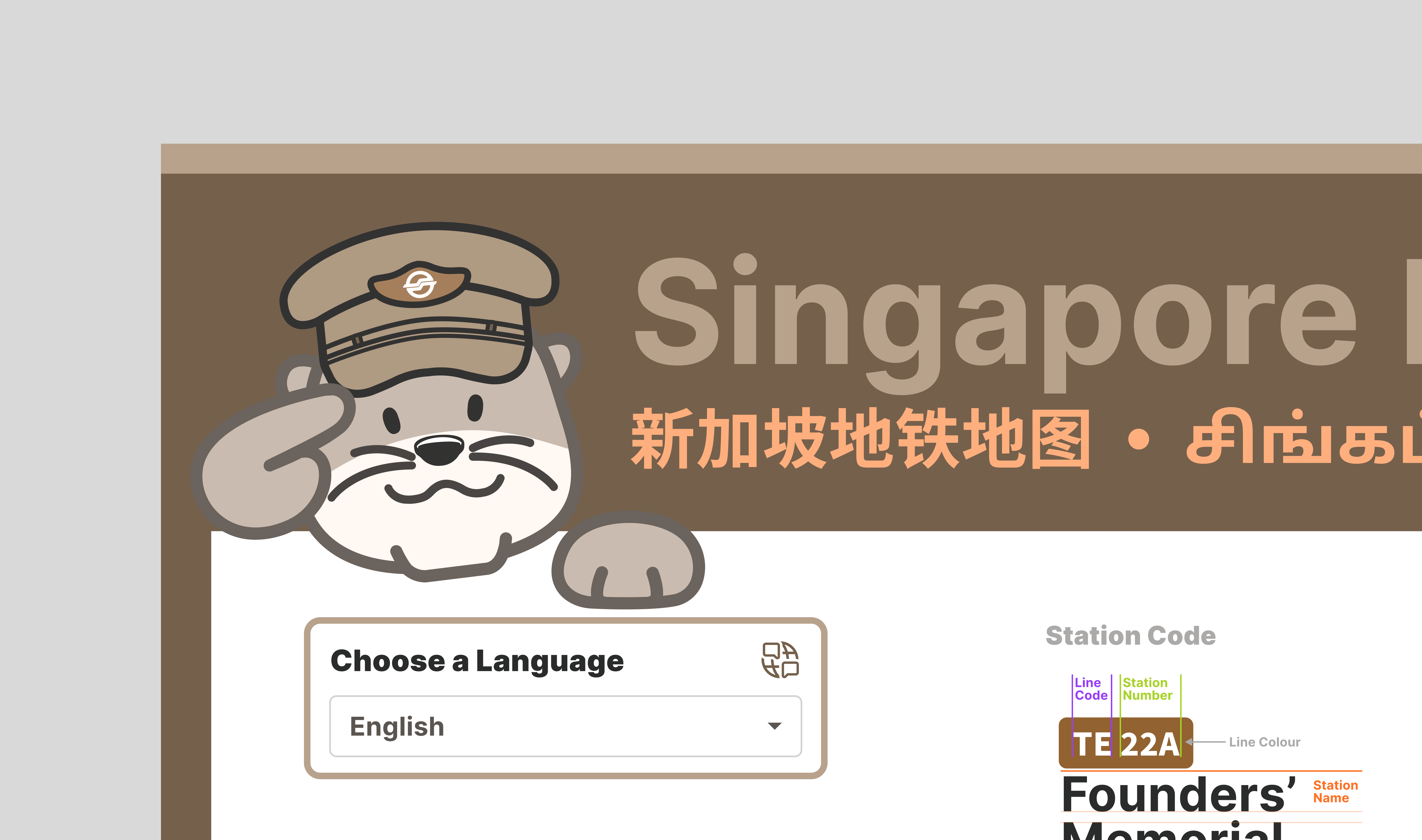
The multilingual interface proposal — introduced in the redesigned system map and carried through into OttoApp — surfaces all four official languages as first-class options, not secondary additions. Language preference set in the app persists across the digital touchpoints of the journey.
For physical wayfinding, the proposal introduces consistent multilingual labelling at the three decision-point anchors — not a translation of every sign, but the critical orientation information (exit labels, interchange directions, disruption notices) available in the language the commuter needs.
Accessibility routing in OttoApp treats step-free access as a default mode, not a filter. The commuter who needs it does not have to seek it out. It is simply part of how the system presents itself.
The Problem
The Solution
Finding 5
Inconsistency in Visual Language and Wayfinding Vernacular
The Problem
The Singapore MRT is operated by three separate entities — SMRT, SBS Transit, and SRAIL — each responsible for different lines. For the commuter, this distinction is invisible and irrelevant. They are riding one network. The experience, however, does not always feel like one network.
Visual language, signage conventions, and wayfinding grammar vary across operator lines in ways that are subtle but cumulative. A commuter transferring from an NEL station to a TEL station may find that the exit labelling convention has shifted, that the landmark references have changed, or that the visual hierarchy of the signage feels different enough to require a moment of recalibration. At the Orchard TEL station, for instance, the signage does not clearly direct commuters toward ION Orchard — a landmark reference so dominant that its absence is the wayfinding gap.
These inconsistencies are not dramatic. But they are felt, particularly by riders who are not yet fluent in the network's unwritten conventions.
Proposed Solution
The Tropical Metro redesign proposes a unified visual grammar that works across all three operator lines — a shared typographic system, a consistent exit labelling convention, and a landmark-first approach to directional signage that prioritises the references commuters actually use. The system map redesign establishes this grammar visually. The wayfinding framework proposes how it extends into the physical environment.
The goal is not uniformity for its own sake. It is the quiet confidence of a network that feels, at every station on every line, like it was designed with the same person in mind.
The Problem
The Solution
Reflections
What began as a map redesign became something larger — an inquiry into what it means to design public infrastructure for everyone who uses it, not just the majority who have learned to navigate despite its gaps.
The guerrilla signage stays with me. Every laminated A4 sheet is a station staff member solving a problem that design should have solved first. Every confused tourist at an interchange is a person the system quietly failed. These aren't edge cases. They are the real users.
Singapore has built something genuinely world-class. This study is not a critique of that achievement — it is an attempt to push the conversation forward. To ask: now that we've built for efficiency, can we also build for warmth? For inclusivity? For the elderly commuter, the first-time visitor, the child on their first solo journey?
This study stands on the shoulders of those who came before it. Designers like Samuel Lim and enthusiasts like Faiz Basha have contributed meaningfully to the ongoing discourse around Singapore's transit map — their independent studies and passion-driven work have pushed the visual language of our network further than any single official brief could. The teams at LTA, SMRT, SBS Transit, and SMRT Trains are themselves in continuous evolution, and the improvements visible across newer stations like those on the TEL reflect a genuine commitment to getting this right. The Tropical Metro does not position itself against that work — it is part of the same conversation, offered in the same spirit of care for this city and everyone who moves through it.
The Tropical Metro is one answer to that question. An incomplete one. A living one.